Essential Skills to Drive Innovation & Creativity:Six Thinking Hats
Revolutionary nature of Parallel Thinking Six Thinking Hats
THE NEED TO CHANGE THINKING BEHAVIOR
We have developed many excellent thinking tool for argument and analysis.
Our information technology methods are constantly improving. But we have developed few
tools to deal with our ordinary everyday thinking - the sort of thinking we do in conversations and
meetings. In fact, our traditional thinking methods have not changed for centuries. While these methods were
powerful in dealing with a relatively stable world (where ideas and concepts tended to live longer
than people), they are no longer adequate to deal with the rapidly changing world of today where
new concepts and ideas are urgently needed."Our traditional thinking methods…..are no longer
adequate to deal with the rapidly changing world of today…."
HISTORICAL BACKGROUND
The fall of the Roman Empire in Europe was
followed by the Dark Ages. The so - called
barbarian hordes swept across what had been the
civilizations of Rome and Greece. Scholarship,
reading, writing, and thinking were only
preserved in the great monasteries and abbeys of
the Church.
Naturally, the thinking that took place in the
monasteries and abbeys was concerned
with theology and with preserving the
doctrine and dogma of the Christian faith.
Then came the Renaissance . T h e
Renaissance was brought about by the
discovery of the classic thinking methods of
the ancient Greek philosophers.
This "new thinking" provided a breath of
fresh air. Humanity was given a more central
role in the universe. Thinkers were allowed
to use reason to work things out. Logic was
now allowed.
It is hardly surprising that this new thinking
was eagerly embraced by the "humanists" or
non - church thinkers because it gave them a
framework for thinking and also for
challenging the church. At the same time,
this new thinking was embraced by church
scholars such as Thomas Aquinas of Naples,
who fashioned Aristotelian logic into a
powerful argumentative way of proving
heretics wrong. So the two main thinking
groups in Western culture adopted, with
eagerness, this classic Greek thinking.
"Church scholars…..fashioned Aristotelian
logic into a powerful, argumentative way of
proving heretics wrong"
ARGUMENT AND CRITICAL THINKING
To this day, Western culture depends on this type
of thinking. In family arguments, in business
discussion, in the law courts, and in governing
assemblies, we use the thinking system of the
Greeks, based on argument and critical thinking.
I sometimes refer to prominent philosophers of
this day as the "gang of three". Who were the
famous Greek gang of three, and how did they form
the thinking habits of Western culture?
THE GANG OF THREE
SOCRATES (469 - 399 B.C.)
Socrates was trained as a "sophist". Sophists were
people who played with words and showed how
careful choice of words could lead you to almost
any conclusion you wanted. Socrates was
interested in challenging people's thinking and,
indeed, getting them to think at all instead of just
taking things for granted. He wanted people to
examine what they meant when they said
something. He was not concerned with building
things up or making things happen.
“From Socrates we get the great emphasis on
argument and critical thinking” Socrates chose to
make argument the main thinking tool. Within
argument, there was to be critical thinking: Why do
you say that? What do you mean by that?
PLATO (C. 427 - 348 B.C.)
Plato is generally held to be the father of
Western philosophy. He is best known for his
famous analogy of the cave. Suppose
someone is bound up so that the person
cannot turn around but can only look at the
back wall of the cave. There is a fire at the
mouth of the cave. If someone comes into the
cave, then the bound person cannot see the
newcomer directly but can only see the
shadow cast by the fire on the back wall of
the cave. So as we go through life, we cannot
see truth and reality but only "shadows" of
these. If we try hard enough and listen to
philosophers, then perhaps we can get a
glimpse of the truth. From Plato we get the
notion that there is the "truth" somewhere
but that we have to search for it to
ARISTOTLE (384-322 B.C.)
Aristotle was the pupil of Plato and the tutor of
Alexander the Great. Aristotle was a very practical
person. He developed the notion of "categories",
which are really definitions So you might have a
definition of a "chair" or a "table". When you come
across a piece of furniture, you have to judge
whether that piece of furniture fits the definition of a chair
The object cannot both be a chair and not
be a chair at the same time. That would be a
"contradiction". On the basis of his categories and
the avoidance of contradiction, Aristotle
developed the sort of logic we still use today
(based largely on "is" and "is not"). From Aristotle
we get a type of logic based on identity and non -
identity, on inclusion and exclusion.
THE OUTCOME OF THE GANG OF THREE
So this was the gang of three. The outcome was a
thinking system based on the search for the
"truth". This search was going to be carried out by
the method of argument. Within argument there
was to be the critical thinking that sought to attack
"untruth". This attack was going to use the
methodology of Aristotle's logic.
THE PERVASIVENESS OF ARGUMENT
To this day, argument is the basis of our normal
thinking. The purest form of this type of thinking is
in the law courts where the prosecution takes one
side of the argument and the defense the other
side. Each strives to prove the other side wrong.
The "truth" is to be reached by argument.
THE INADEQUACY OF ARGUMENT
There is a place for argument, and argument
is a useful tool of thinking. But argument is
inadequate as the main tool of thinking.
Argument lacks constructive energies,
design energies, and creative energies.
Pointing out faults may lead to some
improvement but does not construct
something new. Synthesizing both points of
view does not produce a stream of new
alternatives.
"In my view, we would have been at least
three hundred years ahead if our thinking
had not been limited to the argument
method"
Today in business, as elsewhere, there is a
huge need to be constructive and creative.
There is a need to solve problems and to
open up opportunities. There is a need to
design new possibilities, not just to argue
between two existing possibilities.
PARALLEL THINKING: AN
ALTERNATIVE TO ARGUMENT
Traditional argument is totally useless for
such a design process. Instead, we need
Parallel Thinking ®, where each thinker puts
forward his or her thoughts in parallel with
the thoughts of others - not attacking the
thoughts of others.
The Six Thinking Hats method is a practical
way of carrying out Parallel Thinking. This
method is of fundamental importance
because it provides us, for the first time
with a practical method of
constructive thinking.We now have a more constructive alternative to
argument or drifting discussion.
“We now have a more constructive alternative to
argument or drifting discussion”
It is important to understand this very
fundamental nature of the Six Hats method in
order to appreciate the importance of the method.
The Six Hats system is not just another gimmick.
This system provides an alternative to that most
basic of thinking procedures: the argument.
PARALLEL THINKING AT WORK
In traditional adversarial thinking, A and B are in
conflict.Each side seeks to criticize the other point
of view. The Six Hats method allows Parallel
Thinking. Both A and B wear each hat together as
they explore all sides of an issue. Adversarial
confrontation is replaced by a cooperative
exploration of the subject.
ADVERSARIAL
Mr. A Ms. B
"This proposal won't work" "Yes, it will."
Parallel
Mr. A
"The development costs are high."
Ms. B
"Some components are hard to find".
Mr. A
"We could produce this with existing equipment".
Ms. B
UNBUNDLING THINKING
When we think in the normal way, we try to
do too much at once. We may be looking at
the information, forming ideas, and judging
someone else's ideas all at the same time.
The Six Hats method allows us to un-bundle
thinking. Instead of trying to do everything
at once, we separate out the different aspects
of thinking. This way we can pay full
attention to each aspect in turn. Think of full
color printing, where the basic color
separations are made and then each basic
color is printed separately into the same
sheet to give full color printing .
In the same way, we separate the modes of
thinking and then apply each mode to the
same subject in order to end up with full
color thinking on the subject.
There is suggestion that the chemical setting
in the brain (neurotransmitters, etc.) may be
different when we are being positive from
when we are being negative and from when
we are being creative. If this proves to be so,
then there is an absolute need to separate
out the different components of thinking in
order to do each properly. It would be
impossible to have one brain setting that was
ideal for all sorts of thinking. "Instead of
trying to do everything at once, we separate
out the different aspects of thinking. This
way we can pay full attention to each aspect
in turn".
SEPARATING EGO AND PERFORMANCE
If you do not like an idea, then you are not going to
spend much time thinking of the benefits or good
points of that idea. This is because if you uncovered
sufficient good points for the idea to be accepted,
then you would have "lost" the argument.
With the Six Hats method, however, the thinker can
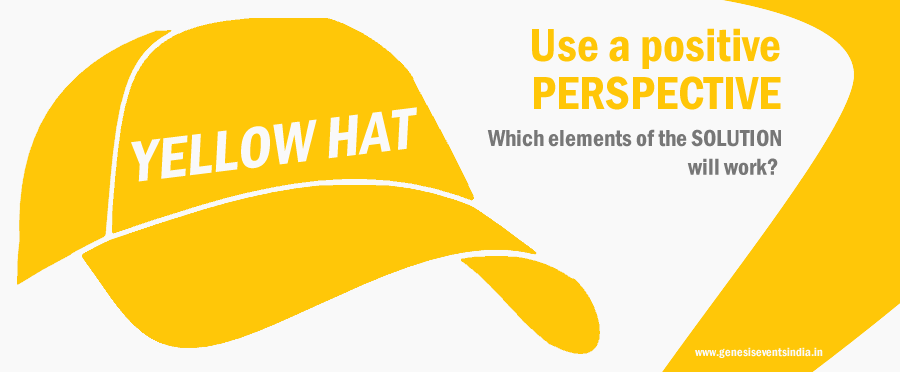
be specifically asked to give a yellow hat
"performance". This is a challenge to the thinker,
who will not want to appear unable to perform this
way. So yellow hat thinking gets done even by
someone who does not like the idea. In the course
of this yellow hat thinking, ideas may turn up
which cause the thinker to change his or her mind.
It also can happen the other way around. A
euphoric supporter of an idea can be asked to do a
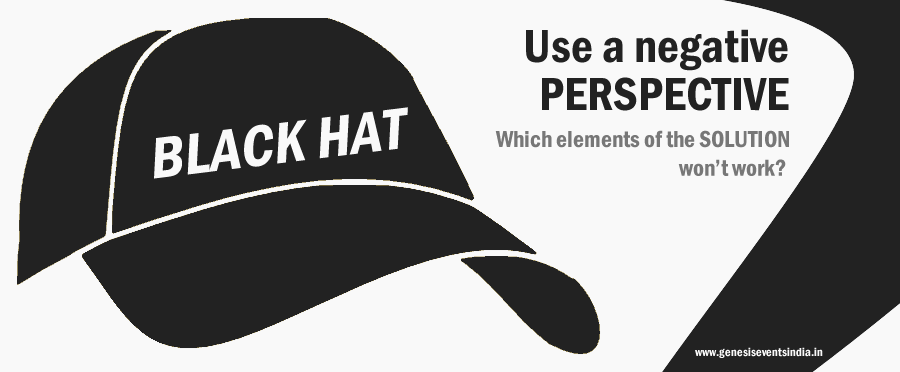
black hat performance. This may turn up
difficulties that reduce the previous euphoria.
"Because the Six Hats system quickly becomes a
neutral game, the method provides a very
convenient way to switch thinking or to ask for a
certain type of thinking”
SWITCHING MODES
If you ask someone not to be so negative, that
person may be offended. But if you ask the person
to do yellow hat thinking, there is no reason to be
offended. You might also say, "That is good black
hat thinking; let us have some more of it." "Later
you would say, "We have had a lot of good black hat
thinking. Now, what about switching to the yellow
hat?”
Because the Six Hats system quickly becomes a
neutral game, the method provides a very
convenient way to switch thinking or to ask for a
certain type of thinking. This is not easy to do in any
other way without offending the people involved
INCREASED AWARENESS
Because there is now a simple and practical
way of referring to different modes of
thinking, people become aware that they are
stuck in one mode or another.
"I think I have only been doing red hat
thinking about this".
"We should make a deliberate yellow hat
effort here".
People can now comment on their own
thinking and can also comment on the
thinking of others. The Six Hats method
allows an increased awareness of what
thinking is actually being used on any
occasion.
WHO IS USING THE SIX THINKING
HATS?
The method is widely used at Prudential
Insurance (the largest insurance group in
the world), and the former president of
Prudential, Rob Barbaro , used the Six Hats
frame work every day with his staff. Siemens
has over 35 certified Six Hats instructors
working with employees throughout its
European offices Boeing is just now taking
up the hats in the United States. The hats are
also in use at Honeywell, Motorola, Eli Lilly,
Cargill , Fidelity Investments, National
Semiconductor, and in many other
companies . Health care groups ,financial
institutions, chemical and
pharmaceutical companies, manufacturers,
and utilities are just a few of the industries
using Six Hats. At the time this revision
was published, over 100,000 people had
been trained in the hats in 35 countries
KEY BENEFITS
Below are some of the key benefits clients
find in using the Six Thinking Hats .
Works - they see results immediately
Simple to learn, use, and implement
Not dependent on others (you can use it by
yourself)
Modified behavior without attacking it
Empowers
Can be used at all levels
Improves cross - cultural interaction
Reduces conflict
Encourages cooperation
Enhances quality of thinking
Supports other change initiatives
Is available worldwide