Transform Complex Challenges into Innovative Solutions
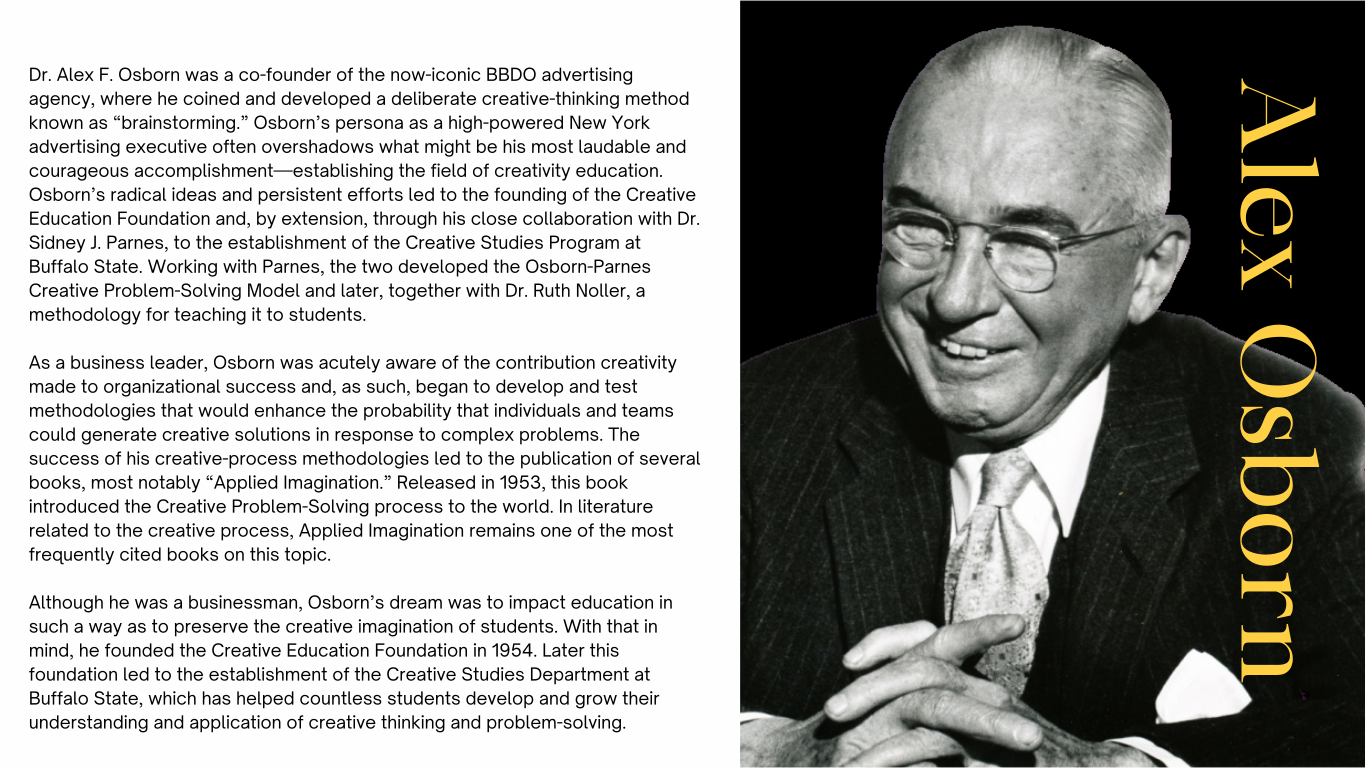
Discover the proven methodology by Alex Osborn, the father of brainstorming. Learn systematic techniques to unlock creative thinking, accelerate innovation, and drive measurable results in your organization.
MUMBAI | 9:30 am - 5:30 pm
Investment : INR 15000 plus GST
Book Your Seat...
BANGALORE | 9:30 am - 5:30 pm
Investment : INR 15000 plus GST
Book Your Seat...
HYEDRABAD | 9:30 am - 5:30 pm
Investment : INR 15000 plus GST
Book Your Seat...
GURUGRAM | 9:30 am - 5:30 pm
Investment : INR 15000 plus GST
Book Your Seat...
Alex Osborn, founder of the Creative Problem Solving (CPS) process, revolutionized how organizations approach innovation. His methodology has been successfully implemented by Fortune 500 companies worldwide to drive breakthrough thinking and sustainable growth.
Learn the six-stage CPS process that balances divergent and convergent thinking to generate, develop, and implement innovative solutions systematically.
Backed by decades of research and application, this methodology has helped organizations achieve 40% faster problem resolution and 3x more innovative outcomes.
Walk away with practical tools and frameworks you can implement immediately in your team meetings, strategy sessions, and decision-making processes.
Develop the ability to generate 5x more ideas and identify breakthrough solutions that others miss in complex business scenarios.
Master evaluation techniques to select the most viable solutions and create actionable implementation plans with measurable outcomes.
Learn facilitation methods to lead creative sessions that engage diverse perspectives and build consensus around innovative initiatives.
Position your organization ahead of competitors by fostering a culture of continuous innovation and adaptive problem-solving.
Enhance your leadership toolkit with creative thinking strategies that inspire teams and drive organizational transformation.
Receive official certification in Creative Problem Solving methodology to validate your expertise and advance your professional credentials.
Core Principles of Creative Problem Solving
Everyone is creative.
Creative skills can be learned and enhanced.
Divergent and Convergent Thinking Must be Balanced. Keys to creativity are learning ways to identify and balance expanding and contracting thinking (done separately), and knowing when to practice them.
Ask Problems as Questions. Solutions are more readily invited and developed when challenges and problems are restated as open-ended questions with multiple possibilities. Such questions generate lots of rich information, while closed-ended questions tend to elicit confirmation or denial. Statements tend to generate limited or no response at all.
Defer or Suspend Judgment. As Osborn learned in his early work on brainstorming, the instantaneous judgment in response to an idea shuts down idea generation. There is an appropriate and necessary time to apply judgement when converging.
Focus on “Yes, and” rather than “No, but.” When generating information and ideas, language matters. “Yes, and…” allows continuation and expansion, which is necessary in certain stages of CPS. The use of the word “but” – preceded by “yes” or “no” – closes down conversation, negating everything that has come before it.
Telephone: 011 41080000
Mobile: +91 9811630393 | +91 8750799811
[email protected]
MUMBAI | 9:30 am - 5:30 pm
Investment : INR 15000 plus GST
Book Your Seat...
BANGALORE | 9:30 am - 5:30 pm
Investment : INR 15000 plus GST
Book Your Seat...
HYDERABAD | 9:30 am - 5:30 pm
Investment : INR 15000 plus GST
Book Your Seat...
GURUGRAM | 9:30 am - 5:30 pm
Investment : INR 15000 plus GST
Book Your Seat...